What Should a Good Brazilian Portuguese Lesson Include?
A good Brazilian Portuguese lesson should connect a clear communication goal with understandable input, active speaking, listening, pronunciation, useful vocabulary and grammar in context. It should also include specific feedback and a realistic next step for practice. The balance changes by level and purpose, but the learner should know what they are practising, why it matters and how to reuse it.
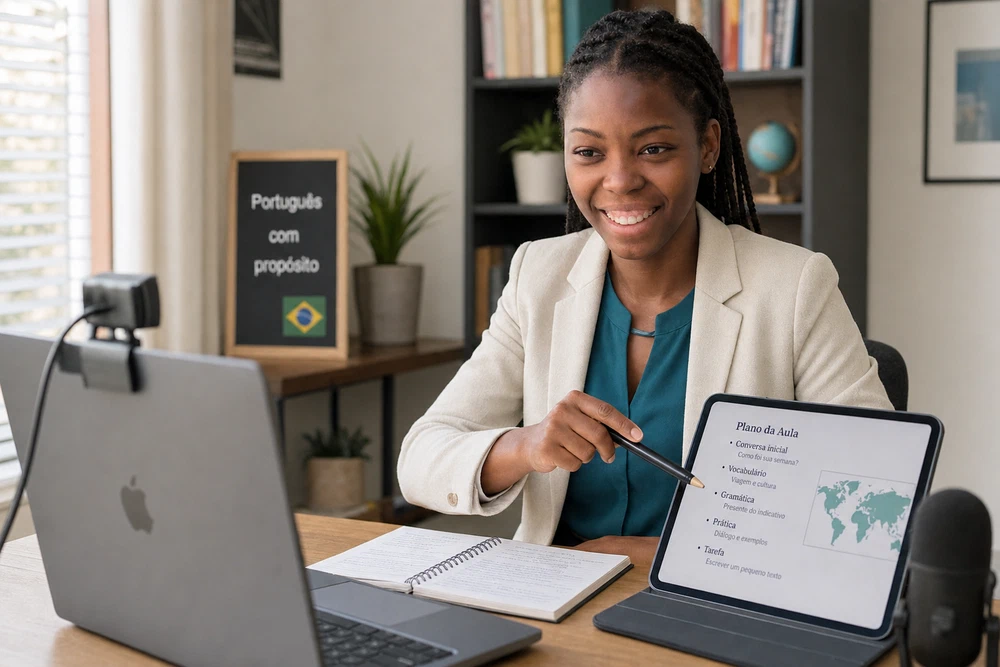
Begin with an outcome, not a list of topics
“Study the past tense” is a topic. “Tell a short story about last weekend and answer follow-up questions” is a communication outcome. A useful lesson connects the language feature to something the learner will understand or say.
A practical lesson checklist
- Purpose: One clear, level-appropriate outcome.
- Input: A short conversation, text or model that the learner can understand with support.
- Active use: Time to retrieve and speak, not only watch or repeat explanations.
- Pronunciation and listening: Attention to sounds, rhythm and connected speech inside meaningful phrases.
- Vocabulary and grammar: Patterns selected because they support the current conversation.
- Feedback: A small number of specific corrections, followed by another chance to use them.
- Follow-up: A manageable task that revisits the lesson rather than introducing unrelated material.
Not every component needs equal time in every session. A beginner may need more modelling; an advanced learner may spend longer refining nuance or responding spontaneously. The important point is that activities serve the goal.
What to notice as a student
By the end, you should be able to identify something you can now understand, say or improve. You should also know which correction matters most and what to practise next. Entertainment and variety can support attention, but a busy lesson is not automatically a coherent one.
Barbara’s teaching perspective
Barbara describes her lessons as a combination of conversation, pronunciation, vocabulary, grammar and cultural context adapted to the learner’s background and objective. Her approach uses feedback and review to turn explanation into language the student can use.
Compare this checklist with the online lesson guide or discuss your goal with Barbara. Ask what you would practise first, how feedback works and what is expected between sessions.
About the author
Barbara Sharon is a Brazilian Portuguese teacher with a Bachelor's degree in Languages and Literature from the Federal University of Rio de Janeiro (UFRJ) and TESOL certification. She teaches private and group lessons online worldwide, with in-person options on the Gold Coast subject to availability.
For independent feedback, read the named student testimonials or check the current Google reviews.