How to Stop Translating When Speaking Portuguese
Stop translating word by word by connecting Portuguese directly with meanings, situations and complete phrases. Practise retrieving useful sentence chunks, answering familiar questions without a script and describing simple images or actions in Portuguese. Translation can still help you check meaning, but repeated listening, speaking and feedback gradually make common language available without building every sentence through English first.
Translation is a stage, not a failure
Beginners naturally use a language they already know to understand a new one. The difficulty appears when every response requires composing a complete English sentence and converting each word. Portuguese word order, verb choices and expressions do not always map directly, so the process becomes slow and unreliable.
Build direct connections
- Link objects and actions to Portuguese words without naming them in English first.
- Learn complete chunks such as ways to give an opinion, ask for clarification or buy thinking time.
- Answer the same question in several ways instead of memorising one script.
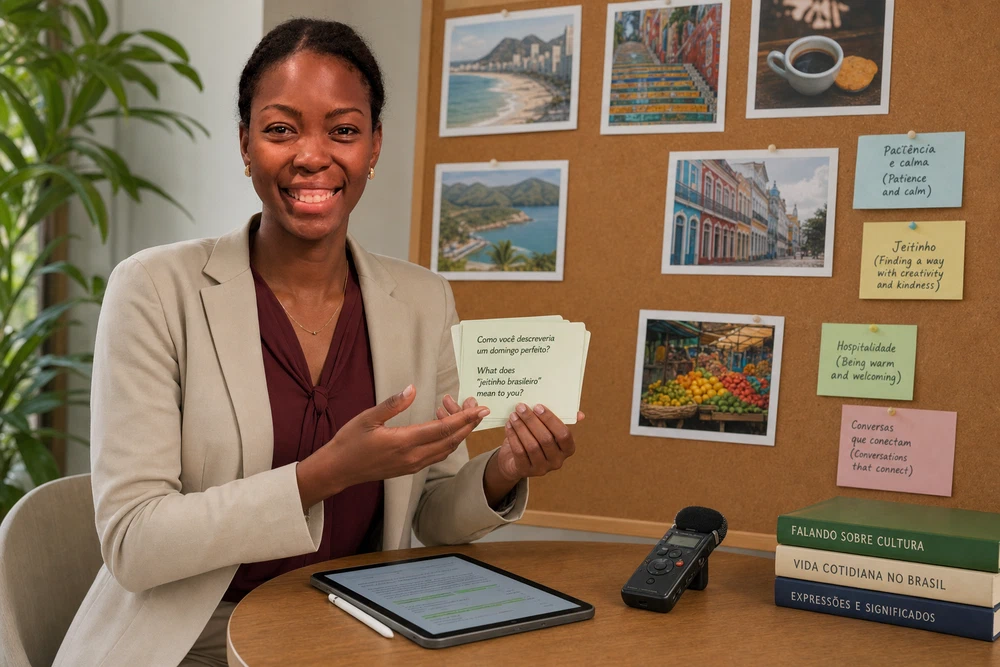
- Describe a simple picture or daily action using only language already available to you.
- Retell a short story from keywords rather than translating a written English paragraph.
Start with brief tasks. Speed is not the first goal; reliable retrieval is. Once a response is available, repeat it with one changed detail and then use it in a less predictable exchange.
Use English deliberately
English can still help compare grammar or confirm an important meaning. Use it as a tool, then return to Portuguese examples. Avoid writing a full English script for every conversation, because that practises translation more than spontaneous speaking.
Barbara’s teaching perspective
Barbara’s approach connects grammar and vocabulary with real conversation and personal goals. Guided questions, role-play and feedback give learners repeated opportunities to retrieve corrected Portuguese rather than only recognise it.
If you understand more than you can say, follow the active-retrieval exercises. Combine them with the between-lesson routine and use a speaking class or private lesson to practise responding without a prepared translation.
About the author
Barbara Sharon is a Brazilian Portuguese teacher with a Bachelor's degree in Languages and Literature from the Federal University of Rio de Janeiro (UFRJ) and TESOL certification. She teaches private and group lessons online worldwide, with in-person options on the Gold Coast subject to availability.
For independent feedback, read the named student testimonials or check the current Google reviews.